
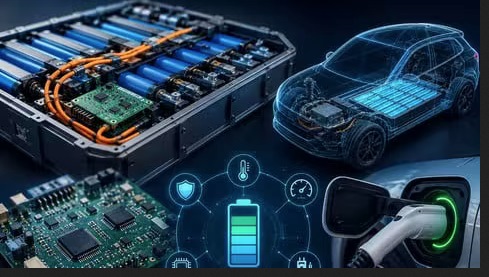
Professional Bms Engineer Certification Program
MP4 | Video: h264, 1920x1080 | Audio: AAC, 44.1 KHz
Language: English | Size: 3.62 GB | Duration: 3h 19m
Master Battery Management System Design, Hardware, Software, EV Charging Integration, SOC/SOH Algorithms, Functional Saf
What you'll learn
Understand lithium-ion battery technologies, cell chemistry, battery pack architecture, and energy storage fundamentals used in modern Electric Vehicles (EVs) a
Implement advanced BMS algorithms for State of Charge (SOC), State of Health (SOH), State of Power (SOP), battery aging analysis, and Remaining Useful Life (RUL
Develop BMS embedded software architecture, communication protocols, diagnostics, fault handling, firmware updates, and real-time control strategies.
Interface BMS with EV chargers using CAN, CAN FD, ISO 15118, CCS, GB /T, and CHAdeMO communication protocols for safe charging operation.
Requirements
No prior Battery Management System (BMS) experience is required; the course starts with battery and BMS fundamentals before progressing to advanced topics.
Description
"This course contains the use of artificial intelligence."Welcome to the Professional BMS Engineer Certification Program, one of the most comprehensive and industry-focused Battery Management System (BMS) courses available for engineers, researchers, students, and professionals working in Electric Vehicles (EVs), Battery Energy Storage Systems (BESS), renewable energy, and advanced battery technologies.Battery Management Systems are the brain of every modern battery-powered system. Whether it is an electric car, energy storage container, solar battery bank, commercial vehicle, e-mobility platform, or grid-scale storage system, the BMS plays a critical role in ensuring battery safety, reliability, performance, longevity, and compliance with industry standards.As the global transition toward electrification accelerates, demand for engineers with expertise in battery systems and BMS technology is growing rapidly. Organizations involved in EV manufacturing, battery production, charger development, renewable energy integration, and energy storage deployment are actively seeking professionals with practical BMS knowledge and implementation skills.This course has been designed to provide a complete understanding of Battery Management Systems, starting from battery fundamentals and progressing to advanced BMS design, implementation, testing, charger integration, safety engineering, and compliance requirements.Unlike traditional courses that focus only on battery basics or theoretical concepts, this program combines battery technology, electronics, embedded systems, communication protocols, charging systems, diagnostics, testing methodologies, and real-world engineering practices into a structured learning experience.Throughout this course, you will gain a thorough understanding of lithium-ion battery technologies, battery pack design, battery protection strategies, state estimation algorithms, cell balancing techniques, thermal management systems, charger communication protocols, embedded software development, functional safety concepts, cybersecurity requirements, testing methodologies, and emerging trends shaping the future of battery technology.You will begin by understanding battery fundamentals, including cell chemistry, battery characteristics, energy storage principles, charging and discharging behavior, battery degradation mechanisms, and safety considerations. The course explains major lithium-ion chemistries such as LFP, NMC, NCA, LTO, and other advanced battery technologies used in modern EVs and energy storage applications.The course then explores battery pack architecture and design principles, including cell selection, series and parallel configurations, module design, high-voltage battery systems, contactors, pre-charge circuits, fuse protection, insulation monitoring, and pack-level safety considerations.A significant portion of the course focuses on Battery Management System architecture and hardware design. Students will learn how to design voltage sensing circuits, current measurement systems, temperature monitoring networks, isolation monitoring systems, power supply architecture, communication interfaces, protection mechanisms, and control circuitry used in commercial BMS products.Advanced battery monitoring and control algorithms are covered in detail. Students will learn how State of Charge (SOC), State of Health (SOH), and State of Power (SOP) are calculated using industry-standard techniques such as Coulomb Counting, Open Circuit Voltage methods, Equivalent Circuit Models, Kalman Filters, Extended Kalman Filters, and AI-based estimation methods.The course also provides in-depth coverage of battery aging mechanisms, degradation analysis, remaining useful life prediction, predictive maintenance techniques, and advanced battery diagnostics used in modern intelligent battery systems.Cell balancing is another critical topic covered extensively. Students will understand the principles, advantages, limitations, and implementation methods of passive balancing, active balancing, capacitor-based balancing, transformer-based balancing, and high-efficiency balancing architectures used in advanced EV battery systems.Battery thermal management is explored from both theoretical and practical perspectives. The course discusses heat generation mechanisms, battery cooling technologies, thermal modeling, liquid cooling systems, air cooling systems, refrigerant cooling methods, phase-change materials, thermal runaway prevention, and safety mitigation strategies.Communication systems are a vital component of modern Battery Management Systems. Students will learn industry-standard communication protocols including CAN, CAN FD, LIN, UART, SPI, I2C, RS485, Ethernet, Modbus, and wireless communication methods. Real-world communication architecture used in EVs and energy storage systems is also explained.One of the most valuable sections of this course focuses on EV charger integration and charging communication protocols. Students will learn how Battery Management Systems communicate with AC and DC chargers, manage charging limits, monitor charging safety, and exchange battery information with charging infrastructure.Advanced charging technologies including CCS (Combined Charging System), ISO 15118, DIN 70121, GB/T, and CHAdeMO protocols are covered in detail. The course also introduces Vehicle-to-Grid (V2G), Vehicle-to-Home (V2H), Vehicle-to-Load (V2L), Plug-and-Charge functionality, and next-generation charging technologies.Embedded software development for Battery Management Systems is another major focus area. Students will learn BMS software architecture, task scheduling, diagnostics implementation, fault handling strategies, watchdog systems, firmware updates, bootloader concepts, data logging, and over-the-air (OTA) update mechanisms.As battery systems become increasingly connected and intelligent, cybersecurity has become essential. This course introduces cybersecurity concepts relevant to battery systems, including secure communication, authentication, encryption, secure boot, firmware protection, threat analysis, and cybersecurity standards such as ISO 21434.The course also covers Functional Safety principles based on ISO 26262 and IEC 61508. Students will learn hazard analysis, risk assessment, ASIL determination, FMEA, FMEDA, safety goals, safety mechanisms, fault tolerance, and validation strategies used in automotive and industrial battery systems.Testing and validation form a critical part of any BMS development program. This course provides detailed coverage of BMS testing methodologies including functional testing, environmental testing, EMC testing, safety testing, charger interoperability testing, HIL testing, SIL testing, reliability testing, and compliance verification.Industry standards and certification requirements are also discussed, including IEC 62619, IEC 62660, UL 1973, UL 2580, ISO 15118, ISO 26262, ISO 21434, UN 38.3, IEC 61508, and other relevant standards used in battery, EV, and energy storage industries.The course further explores Battery Energy Storage Systems (BESS), renewable energy integration, microgrid applications, utility-scale storage systems, smart energy management, and grid support services. Students will gain insight into how BMS technology is applied beyond electric vehicles in large-scale industrial and utility applications.In addition to current technologies, the course introduces emerging trends such as AI-enabled BMS, machine learning applications, digital twins, cloud-connected battery platforms, wireless BMS architectures, predictive maintenance, solid-state battery management, and next-generation energy storage solutions.By the end of this course, you will have a complete understanding of Battery Management Systems from both theoretical and practical engineering perspectives. You will be able to understand, design, evaluate, test, validate, and implement BMS solutions for Electric Vehicles, Battery Energy Storage Systems, renewable energy applications, industrial battery systems, and future battery technologies.Whether you are an engineering student seeking industry-ready skills, a professional looking to transition into the EV or battery industry, or an experienced engineer aiming to deepen your expertise, this course will provide the knowledge and confidence needed to excel in one of the fastest-growing sectors of modern engineering.Join the Professional BMS Engineer Certification Program and take the next step toward becoming a highly skilled Battery Management System Engineer capable of contributing to the future of electrification, sustainable energy, and advanced battery technologies.
This course is designed for anyone who wants to develop expertise in Battery Management Systems (BMS) for Electric Vehicles (EVs), Battery Energy Storage Systems (BESS), renewable energy storage, and advanced battery applications.
Https://anonymz.com/?
https://www.udemy.com/course/professional-bms-engineer-certification-program
https://rapidgator.net/file/2a420bf98b2da5570aa82efecf0a103c/Professional_Bms_Engineer_Certification_Program.part4.rar.html
https://rapidgator.net/file/4ba57db819b … 3.rar.html
https://rapidgator.net/file/b395dbf9fc0 … 2.rar.html
https://rapidgator.net/file/168573da5a0 … 1.rar.htmlhttps://nitroflare.com/view/E46694BD9CB … .part4.rar
https://nitroflare.com/view/C283D48BD9B … .part3.rar
https://nitroflare.com/view/B36A851D61F … .part2.rar
https://nitroflare.com/view/DC3F6F00281 … .part1.rar

