
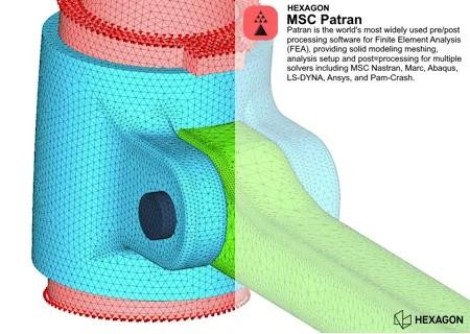
Hexagon MSC Patran 2025.2 | 2.1 Gb
Hexagon is pleased to announce the release of MSC Patran 2025.2 is most widely used pre/post-processing software for Finite Element Analysis (FEA).
Patran, the world's most widely used pre/post-processing software for Finite Element Analysis (FEA), introduces new capabilities in version 2025.2. This Patran release introduces advanced rotordynamics capabilities, full support for MSC Nastran Monitor Sum cards, superelement import, composite and nonlinear enhancements, new beam and gap modeling options, HDF5-based postprocessing with XY plots, Von Mises stress and contact outputs, improved part-based model organization, and Catia V5 R34 CAD import-delivering greater accuracy, scalability, and efficiency for complex engineering workflows.
Hybrid Damping Data for Rotors: A New Era in Rotordynamic Analysis
The latest Patran release introduces the Hybrid Damping Data for Rotors feature, delivering unprecedented flexibility and precision in rotordynamic simulations. This capability allows engineers to define accurate damping characteristics for rotors across all major analysis types, including SOL101, SOL103, SOL110, SOL107, SOL111, SOL108, SOL109, SOL128, and SOL400. By supporting unlimited rotors, the feature ensures scalability for complex assemblies without restrictions on rotor count. Engineers can assign unique damping behavior to each rotor in 1D, 2D, or 3D, enabling tailored modeling for diverse engineering scenarios. Full export and read support from Nastran input files guarantees seamless integration with existing workflows, reducing setup time and complexity. Applicable to all rotodynamic applications, this enhancement supports advanced studies for multi-rotor systems without compromise. The intuitive interface makes defining damping data for multiple rotors user-friendly and efficient. By capturing real-world damping behavior, engineers achieve improved simulation fidelity and confidence in results. Advanced damping matrices allow users to balance detail and computational performance, ensuring optimal efficiency. With this feature, Patran empowers engineers to deliver optimized designs, enhance system reliability, and accelerate innovation in aerospace, automotive, and industrial sectors.
MSC Nastran Solver and Card Support 2025.2
Comprehensive Support for MSC Nastran Monitor Sum Cards
The latest Patran enhancement introduces full pre- and post-processing support for MSC Nastran Monitor Sum cards, including Monitor Sum, Monitor Sum1, and Monitor Sumt. This functionality ensures seamless integration with existing workflows by supporting MONITOR case control and bulk section entries such as MONSUM, MONSUM1, and MONSUMT. Engineers can now save Monitor Sums directly in the database, enabling efficient data management and quick access to critical performance metrics. Post-processing capabilities allow users to review and analyze monitored quantities with ease, providing clear insights throughout the simulation process. The feature supports a wide range of solution sequences, including SOL101, SOL103, SOL108, SOL109, SOL111, SOL112, and SOL400, making it ideal for both linear and nonlinear structural analyses. By leveraging these capabilities, engineers can validate simulation accuracy by comparing results with physical test data, ensuring confidence in design performance. This reduces reliance on extensive physical testing, streamlines verification processes, and accelerates development cycles. The intuitive workflow simplifies monitoring at specific locations using MONSUM definitions, even in complex models. Ultimately, this enhancement helps shorten time to market while improving reliability and efficiency in structural analysis. With Monitor Sum support in structure and implicit preference, Patran delivers a powerful tool for engineers seeking precision, productivity, and robust design validation.
Streamlined Superelement Integration with BEGIN SUPER Support
The latest Patran enhancement introduces full recognition and handling of BEGIN SUPER sections, enabling seamless import of nodes, elements, and MPCs from each section into organized groups. Coordinates are imported accurately, and duplicate ID offsets are applied to nodes, elements, MPCs, and related references such as materials, loads, properties, and fields. Users are prompted to confirm offset adjustments to maintain consistency, while identically located nodes are preserved without duplication to ensure model integrity. A primary superelement (SE) definition is automatically created with proper association to its group and boundary nodes. Analysis job setup now supports selected superelements, and DOF sets (ASET/QSET) are imported with duplicate or offset node IDs for complete compatibility. This workflow simplifies the integration of superelements into complex models, reducing manual effort and improving accuracy. Engineers can easily import existing superelement models, saving time and leveraging prior work for new analyses. The feature also facilitates secure data exchange between companies by sharing essential structural data while protecting proprietary details. Modular workflows enable parallel processing and independent development of substructures, accelerating project turnaround. With these capabilities, Patran delivers a robust solution for managing large-scale assemblies and enhancing efficiency in advanced structural analysis.
Advanced Support for Composite and Nonlinear Analysis CPENTA
Patran introduces a powerful enhancement for composite and nonlinear analysis, enabling engineers to model complex structures with greater accuracy and flexibility. This functionality supports specific element-property combinations, including CPENTA elements with PCOMPLS, CTRIA3 and CTRIA6 elements with PCOMP or PCOMPG for interlaminar shear evaluation, and CPENTA elements with MATG material definitions. Designed exclusively for implicit nonlinear preference, these capabilities apply to nonlinear performance (NLPERF) analyses, ensuring precise handling of advanced scenarios. The feature is limited to CPENTA6 elements, avoiding higher-order configurations for optimal control and reliability. Import and forward translation are fully supported, allowing seamless integration of geometry-associated elements into the analysis workflow. By incorporating these enhancements, engineers can achieve robust modeling of nonlinear composite behavior in demanding structural simulations. This improvement eliminates inefficiencies caused by relying solely on CHEXA elements for solid shell formulations, streamlining meshing and reducing complexity. CPENTA support expands modeling options for intricate geometries, delivering greater flexibility in nonlinear analysis. Engineers benefit from improved simulation fidelity, reduced constraints, and faster project turnaround. With this capability, Patran empowers users to tackle advanced composite challenges confidently, ensuring optimized designs and superior performance.
Enhanced Support for Double-Sided Blade Cross-Sections: PBARL, PBEAML
Patran now introduces support for double-sided blade (DSB0 and DSB1) cross-sections in both PBARL and PBEAML entries, delivering greater flexibility for defining beam properties in advanced structural models. For PBEAML entries, the cross-sectional interface calculates both the centroid and shear center, while PBARL determines only the centroid for accurate property definition. Internally, PBARL generates the appropriate PBAR entry for CBAR elements, including section properties and stress recovery locations (C, D, E, F) relative to the centroid. Similarly, PBEAML creates the corresponding PBEAM entry for CBEAM elements, ensuring stress recovery locations are referenced to the shear center for maximum precision. This enhancement improves the accuracy of structural behavior representation and stress recovery for complex blade-like geometries. Engineers benefit from streamlined workflows, as the new section types eliminate manual adjustments and reduce setup time. The addition of DSB0 and DSB1 sections ensures high-fidelity modeling and better correlation with physical testing. By supporting precise calculation of sectional properties, Patran enables robust analysis of arbitrary cross-sections using default methods. These improvements enhance modeling flexibility for aerospace, automotive, and industrial applications where blade-like structures are common. Overall, this feature empowers engineers to achieve optimized designs and reliable performance in demanding structural simulations.
Linear Gap Capability for Efficient Contact Modeling
Patran now introduces a linear gap capability using CGAP elements, designed to model simple contact behavior between two parts under compressive conditions. This approach excludes friction, large displacements, and material nonlinearity, making it ideal for scenarios where straightforward contact representation is sufficient. Common applications include hole bearing, heel-toe interaction, and fitting contacts in structural assemblies. Integrated into SOL101, engineers can specify linear contact through LGAP case control options such as LGAP=ALL, LGAP(MITER=75)=ALL, and LGAP(MITER=20,PRTN=YES)=75. These options provide flexibility in defining contact behavior while maintaining computational efficiency for static linear solutions. By leveraging this capability, engineers can accurately simulate localized contact effects without introducing unnecessary complexity into the model. The feature also supports constrained structures and works seamlessly with inertia relief using PARAM,INREL,-1 or -4, enabling analysis of unconstrained or partially constrained systems. This enhancement ensures reliable contact modeling for designs requiring precision under compressive forces. Engineers benefit from reduced setup time, improved accuracy, and streamlined workflows for linear analysis. Overall, the linear gap capability empowers users to achieve efficient and accurate structural simulations for simple contact scenarios.
Enhanced Part-Based Model Organization for Complex Assemblies
Patran now introduces advanced model handling based on parts and assemblies, delivering significant improvements for aerospace and automotive applications. This enhancement extends part functionality by supporting nodes, MPCs, and connectors, enabling more comprehensive and flexible modeling. New entities are fully integrated into the database for saving, loading, and importing, ensuring smooth data management throughout the workflow. A new part creation method based on nodes, MPCs, and connectors simplifies setup and reduces manual effort. All part operations, including import/export, visibility control, and color management, have been optimized for efficiency. Updates to part entities during FEM actions such as renumbering or deletion maintain consistency and prevent errors in large-scale models. Additionally, the "Organize Model" tool provides streamlined management of complex assemblies, making it easier to maintain clarity and control. These improvements offer a hierarchical structure for model management, allowing users to create, edit, review, and visualize data in an intuitive way. By reducing complexity and accelerating setup, engineers benefit from improved productivity and usability. With a modern interface and enhanced functionality, Patran delivers a user-friendly experience that aligns with contemporary design standards and supports advanced engineering workflows.
HDF5 Support 2025.2
Enhanced Visualization with XY Plotting of Monitor Results
Patran now introduces XY plotting of monitor results, providing engineers with a clear and intuitive way to visualize key performance metrics against global variables such as time or frequency. This functionality allows users to generate plots for Monitor Point 1, Monitor Point 2, and Monitor Disp1, offering detailed insights into system behavior during analysis. By correlating monitored quantities with global parameters, engineers can easily track trends, identify anomalies, and validate simulation accuracy. The ability to compare multiple result cases in a single view enhances understanding of system performance and supports better decision-making. These plots transform complex numerical outputs into precise graphical representations, streamlining postprocessing workflows and improving efficiency. Applicable to both dynamic and static analyses, the feature supports scenarios such as frequency response and time-dependent simulations. Engineers benefit from comprehensive visualization tools that simplify interpretation and accelerate reporting. This capability ensures that critical data is presented in an accessible format, reducing the risk of misinterpretation and improving design validation. By integrating XY plotting into the workflow, Patran empowers users to optimize designs and achieve higher confidence in simulation results. Overall, this enhancement delivers a powerful combination of clarity, usability, and analytical depth for advanced structural and dynamic analysis.
Von Mises Stress Output for SOL111 Random Analysis
Patran now introduces Von Mises stress output capability in SOL111 random analysis postprocessing, delivering critical insights into structural performance under stochastic loading conditions. Using STRESS options such as CRMS, RMSVM, or RALL, engineers can evaluate combined stress states and identify potential failure regions with greater accuracy. This functionality supports shell elements like CQUAD4, CQUAD8, CQUADR, CTRIA3, CTRIA6, and CTRIAR, as well as solid elements including CHEXA, CTETRA, and CPENTA. It is important to note that Von Mises stress is not calculated for shell and solid composite elements in this context, ensuring clarity in application. By enabling precise stress assessment for supported element types, this feature enhances the reliability of random vibration analysis and supports robust design validation. Engineers can now identify stress hotspots under stochastic conditions, improving durability and fatigue life predictions. The PSD-based methodology ensures consistency across tools, delivering equivalent results to MSC Random and CAE Fatigue for uniform workflows. This integration eliminates the need for external tools by implementing PSD evaluation directly within MSC Nastran, streamlining processes and reducing complexity. Applicable to aerospace, automotive, and other high-performance industries, this enhancement accelerates validation and optimizes design confidence. Overall, Von Mises stress output in SOL111 empowers engineers to achieve accurate, efficient, and reliable analysis for demanding structural applications.
NLPERF Contact Output: Advanced Postprocessing for Nonlinear Contact Analysis
MSC Nastran now introduces a powerful NLPERF contact output capability, delivering detailed postprocessing information for nonlinear contact analyses. This enhancement provides engineers with comprehensive results such as contact forces, penetration depth, and status indicators for each contact pair, enabling accurate evaluation of component interactions. By supporting implicit nonlinear preferences, the feature improves correlation with physical testing and enhances confidence in simulation accuracy. Engineers can now access and review critical data like Contact Gap Distance, Contact Gap Status, and Contact Gap Translational, ensuring clarity in complex contact scenarios. These outputs are essential for validating designs in industries where contact performance is critical, including aerospace, automotive, and industrial machinery. The functionality streamlines workflows by allowing efficient interpretation of contact behavior, reducing development time and improving design optimization. With precise insights into nonlinear contact performance, engineers can identify potential issues early and make informed decisions to enhance reliability. This capability also supports robust integration with existing analysis processes, minimizing setup complexity and ensuring consistency. Overall, NLPERF contact output empowers users to achieve higher accuracy, better physical correlation, and improved efficiency in nonlinear analysis workflows.
Patran Explore Tool Now Supports MSC Nastran HDF5 Results
Patran has extended its Explore tool capabilities by adding support for MSC Nastran HDF5 result files (.h5), enabling advanced postprocessing under the familiar Tools | Results | Explore menu. This enhancement ensures a seamless transition for users by maintaining the same workflow as existing XDB file support, minimizing learning effort. The updated interface allows easy selection between .xdb and .h5 files, providing flexibility and convenience for diverse analysis needs. By integrating HDF5 support, Patran simplifies result handling and ensures compatibility with modern MSC Nastran output formats. Engineers can now perform Explore operations directly on HDF5 files, including envelope postprocessing, for faster and more robust analysis. This capability improves performance and scalability, making it ideal for handling large datasets efficiently. The enhancement also future-proofs workflows by aligning with industry trends toward high-performance data formats. Users benefit from streamlined postprocessing that reduces complexity and accelerates decision-making. With this update, Patran delivers a powerful combination of speed, reliability, and flexibility for advanced engineering projects. Overall, HDF5 support in Explore empowers engineers to optimize workflows and achieve greater productivity in structural and dynamic analysis.
MSC Patran, one of the world's most widely used pre- and post-processing software for Finite Element Analysis (FEA), providing solid modeling, meshing, analysis setup and post-processing for multiple solvers including MSC Nastran, Marc, Abaqus, LS-DYNA, ANSYS, and Pam-Crash. Also MSC Patran provides a rich set of tools that streamline the creation of analysis-ready models for linear, nonlinear, explicit dynamics, thermal, and other finite element solutions. From geometry cleanup tools that make it easy for engineers to deal with gaps and slivers in CAD to solid modelling tools that enable the creation of models from scratch, Patran makes it easy for anyone to create FE models.
Basic tutorial of MSC Nastran and Patran Finite Element Analysis (FEA): Bracket structural analysis
In this video, the very simple simulation for bracket structural analysis is done step-by-step using Patran and solved with MSC Nastran. From geometry import, meshing, setup, and post-processing.
Hexagon is a global leader in sensor, software and autonomous solutions. We are putting data to work to boost efficiency, productivity, and quality across industrial, manufacturing, infrastructure, safety, and mobility applications. Our technologies are shaping urban and production ecosystems to become increasingly connected and autonomous - ensuring a scalable, sustainable future. MSC Software, part of Hexagon's Manufacturing Intelligence division, is one of the ten original software companies and a global leader in helping product manufacturers to advance their engineering methods with simulation software and services.
Owner: Hexagon AB
Product Name: MSC Patran
Version: 2025.2
Supported Architectures: x64
Website Home Page : https://hexagon.com/
Languages Supported: english
System Requirements: Windows *
Size: 2.1 Gb
Added by 3% of the overall size of the archive of information for the restoration
No mirrors please
https://ddownload.com/wj0dqcia0pgr
https://ddownload.com/685eeetmd063
https://ddownload.com/te851m07wdsb
https://ddownload.com/w17301o01rx7
https://ddownload.com/nrqhzhk5d7hn
https://ddownload.com/acg2zt3yjd5z
https://ddownload.com/zhkzwn6k1aee
https://rapidgator.net/file/decb948f0ab2704fb7be9399ab39649c/
https://rapidgator.net/file/9b2ab0a351c1cd452210080cf74acfbe/
https://rapidgator.net/file/29680caf06f7d219be66a50b6745ef46/
https://rapidgator.net/file/0571d3ce3ec398a625240e7704e9c6bd/
https://rapidgator.net/file/d76715985cec4094d098af7dd20121d3/
https://rapidgator.net/file/e7388c45f957da3c16287a47616c46df/
https://rapidgator.net/file/9b78cf1df31aec568068d824ff7602eb/
https://nitroflare.com/view/39725CBBF7B9A9D/
https://nitroflare.com/view/9EE18EFFF4CB2A9/
https://nitroflare.com/view/C6A2164375F5F29/
https://nitroflare.com/view/2EED9CACA0449ED/
https://nitroflare.com/view/C1D0A46BDF6C581/
https://nitroflare.com/view/2742E6E04A371EF/
https://nitroflare.com/view/519DD8FB1CB37D6/

