
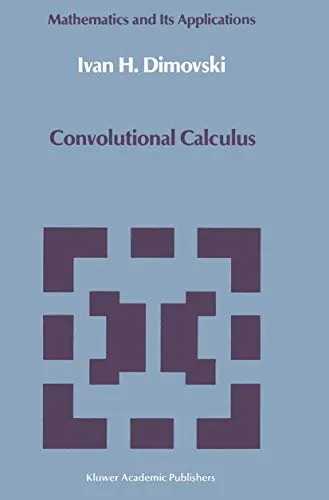
Free download скачать Convolutional Calculus by Ivan H. Dimovski
English | PDF | 1990 | 196 Pages | ISBN : 9401067236 | 31.9 MB
Mathematics is a tool for thought. A highly necessary tool in a world where both feedback and non- linearities abound. Similarly, all kinds of parts of mathematics serve as tools for other parts and for other sciences.
Applying a simple rewriting rule to the quote on the right above one finds such statements as: 'One service topology has rendered mathematical physics .. .'; 'One service logic has rendered com- puter science .. .'; 'One service category theory has rendered mathematics .. .'. All arguably true. And all statements obtainable this way form part of the raison d'etre of this series.
This series, Mathematics and Its Applications, started in 1977. Now that over one hundred volumes have appeared it seems opportune to reexamine its scope. At the time I wrote
"Growing specialization and diversification have brought a host of monographs and textbooks on increasingly specialized topics. However, the 'tree' of knowledge of mathematics and related fields does not grow only by putting forth new branches. It also happens, quite often in fact, that branches which were thought to be completely disparate are suddenly seen to be related. Further, the kind and level of sophistication of mathematics applied in various sciences has changed drastically in recent years: measure theory is used (non-trivially) in regional and theoretical economics; algebraic geometry interacts with physics; the Minkowsky lemma, coding theory and the structure of water meet one another in packing and covering theory; quantum fields, crystal defects and mathematical programming profit from homotopy theory; Lie algebras are relevant to filtering; and prediction and electrical engineering can use Stein spaces. And in addition to this there are such new emerging subdisciplines as 'experimental mathematics', 'CFD', 'completely integrable systems', 'chaos, synergetics and large-scale order', which are almost impossible to fit into the existing classification schemes. They draw upon widely different sections of mathematics."
By and large, all this still applies today. It is still true that at first sight mathematics seems rather fragmented and that to find, see, and exploit the deeper underlying interrelations more effort is needed and so are books that can help mathematicians and scientists do so. Accordingly MIA will continue to try to mjtke such books available.
If anything, the description I gave in 1977 is now an understatement. To the examples of interaction areas one should add string theory where Riemann surfaces, algebraic geometry, modu- lar functions, knots, quantum field theory, Kac-Moody algebras, monstrous moonshine (and more) all come together. And to the examples of things which can be usefully applied let me add the topic 'finite geometry'; a combination of words which sounds like it might not even exist, let alone be applicable. And yet it is being applied: to statistics via designs, to radar/sonar detection arrays (via finite projective planes), and to bus connections of VLSI chips (via difference sets). There seems to be no part of (so-called pure) mathematics that is not in immediate danger of being applied. And, accordingly, the applied mathematician needs to be aware of much more. Besides analysis and numerics, the traditional workhorses, he may need all kinds of combinatorics, algebra, probability, and so on.
In addition, the applied scientist needs to cope increasingly with the nonlinear world and the extra mathematical sophistication that this requires. For that is where the rewards are. Linear models are honest and a bit sad and depressing: proportional efforts and results. It is in the non- linear world that infinitesimal inputs may result in macroscopic outputs (or vice versa). To appreci- ate what I am hinting at: if electronics were linear we would have no fun with transistors and com- puters; we would have no TV; in fact you would not be reading these lines.
There is also no safety in ignoring such outlandish things as nonstandard analysis, superspace and anticommuting integration, p-adic and ultrametric space. All three have applications in both electrical engineering and physics. Once, complex numbers were equally outlandish, but they fre- quently proved the shortest path between 'real' results. Similarly, the first two topics named have already provided a number of 'wormhole' paths. There is no telling where all this is leading - fortunately.
[/b]
Buy Premium From My Links To Get Resumable Support,Max Speed & Support Me
Uploady
a3ajg.7z
Rapidgator
a3ajg.7z.html
UploadCloud
a3ajg.7z.html
Fikper
a3ajg.7z.html
FreeDL
a3ajg.7z.html
Links are Interchangeable - Single Extraction

