
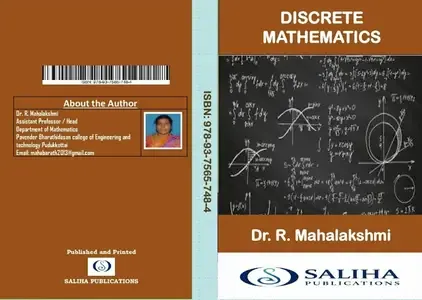
DISCRETE MATHEMATICS
by Dr. Mahalakshmi R.
English | 2026 | ASIN: B0GL9M82VL | 108 Pages | PDF | 59 MB
Discrete Mathematics forms the mathematical foundation of computer science, information technology, data science, and many areas of modern engineering. Unlike continuous mathematics, which deals with real numbers and smooth functions, Discrete Mathematics focuses on distinct, countable, and finite or infinite discrete structures. These structures play a crucial role in the design, analysis, and implementation of algorithms, computer networks, databases, cryptographic systems, and intelligent machines.
With the rapid growth of computing and digital technologies, the importance of Discrete Mathematics has increased significantly. Concepts such as logic, sets, relations, functions, graphs, trees, and combinatorics provide the language and tools necessary to model computational problems and reason about their solutions. This subject enables students to develop precise thinking, problem-solving abilities, and a strong analytical mindset essential for computer-based disciplines.
This course, Discrete Mathematics , is designed to introduce students to the fundamental concepts and techniques required for understanding discrete structures and their applications. The subject begins with propositional and predicate logic, which form the basis for mathematical reasoning, algorithm correctness, and digital circuit design. Set theory and functions are introduced next, providing a framework for representing collections of objects and mappings between them.
Relations and their properties are explored to help students understand data relationships and database design. Graph theory, one of the most powerful tools in discrete mathematics, is presented with applications in networking, routing, social networks, and scheduling problems. Trees and their properties are studied with relevance to data structures, file systems, and hierarchical modeling.
Combinatorics and counting techniques are emphasized for solving problems related to permutations, combinations, probability, and algorithm analysis. Recurrence relations and discrete probability concepts are also introduced to support the study of algorithm efficiency and stochastic processes. Mathematical induction, an essential proof technique, is used throughout the subject to establish the correctness of formulas and algorithms.
The book adopts a logical and progressive approach, presenting concepts from basic principles to more advanced topics. Each chapter includes clear definitions, illustrative examples, diagrams, and solved problems to enhance understanding. The focus is not only on learning mathematical techniques but also on applying them to real-world computational and logical problems.
This material is suitable for undergraduate students in computer science, information technology, engineering, mathematics, and related disciplines. It also serves as a foundational course for advanced subjects such as algorithms, artificial intelligence, cryptography, automata theory, database systems, and computer networks.
By studying Discrete Mathematics, learners gain the ability to think logically, reason rigorously, and solve complex problems systematically. The subject equips students with essential tools that support both theoretical understanding and practical applications in computing and beyond. Ultimately, Discrete Mathematics acts as a bridge between abstract mathematical reasoning and real-world computational problem solving.
Buy Premium From My Links To Get Resumable Support,Max Speed & Support Me
Rapidgator
hvlev.7z.html
FreeDL
hvlev.7z.html
AlfaFile
hvlev.7z
Links are Interchangeable - Single Extraction

