
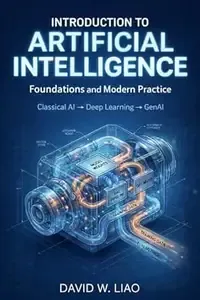
Introduction to Artificial Intelligence: Foundations and Modern Practice: From Classical AI to Deep Learning and GenAI
English | 9 Jan. 2026 | ASIN: B0GFNVRRN9 | 779 pages | Epub | 84.19 MB
Introduction to Artificial Intelligence: Foundations and Modern Practice is a modern, developer-friendly guide to the full AI journey, from the classical symbolic AI to deep learning, Transformers, and today's Generative AI systems. This book is designed for readers who don't just want definitions-they want usable intuition , practical skills , and a clear path from "I've heard of this" to "I can build with this." You'll learn how AI systems think (in the computational sense), how they learn from data, why they sometimes fail, and how to adopt an engineering workflow to ensure they are reliable enough for real-world use. While mathematics certainly helps, this book focuses on the concepts that matter most to AI practitioners: the mental models behind algorithms, the trade-offs in design decisions, and the workflows professionals use to turn models into products. When math appears, it's there to sharpen intuition-not to intimidate. As you progress, you'll move from core learning paradigms (supervised and unsupervised learning, feature thinking, evaluation, and ethics) into deep learning with PyTorch, computer vision with CNNs, and the evolution of NLP into Transformers. From there, the focus shifts to modern GenAI engineering: prompt design as a form of "natural-language programming," integrating LLMs via APIs and local inference, and production patterns such as RAG, fine-tuning, and systematic evaluation to reduce hallucinations and improve accuracy. The final sections connect the dots with agents , reinforcement learning , alignment , and MLOps/LLMOps , showing what it takes to ship AI responsibly at scale. What you'll learn inside How classical AI (logic, search, agents) connects to modern machine learning. Supervised vs. unsupervised learning, features, generalization, and evaluation. Neural networks in practice with PyTorch. Computer vision foundations with CNNs and modern workflows. NLP foundations (RNNs and LSTMs) and the rise of Transformers. Prompt engineering patterns for dependable, structured outputs. Practical LLM integration: APIs, tool use, and local inference. RAG vs. fine-tuning : when to use each, and how to evaluate improvements. Building safer systems: testing, monitoring, guardrails, and ethics-by-design. Agents, feedback loops, and the engineering mindset for AI products Who this book is for Students and early-career developers who are learning AI seriously for the first time. Software engineers and IT professionals who want to build with modern AI (not just read about it). Instructors and self-learners looking for a structured, end-to-end AI roadmap. If you want a single book that connects the full story- Classical AI → Deep Learning → Generative AI Systems -with practical, developer-oriented guidance, this is your starting point.
Buy Premium From My Links To Get Resumable Support,Max Speed & Support Me
Rapidgator
2518q.7z.html
DDownload
2518q.7z
FreeDL
2518q.7z.html
AlfaFile
2518q.7z
Links are Interchangeable - Single Extraction

