
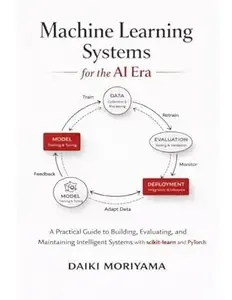
Machine Learning Systems for the AI Era: A Practical Guide to Building, Evaluating, and Maintaining Intelligent Systems with scikit-learn and PyTorch ... of Software and Data Systems in the AI Era)
English | 11 Jan. 2026 | ASIN: B0GG9YV76H | 342 pages | EPUB (True) | 3.21 MB
Machine learning has matured-but most books still treat it as a collection of models rather than a system that must survive real-world use. In practice, machine learning fails not because of weak algorithms, but because of poor problem framing, fragile data pipelines, misleading evaluation, and neglected feedback loops. Models that look impressive in notebooks often break quietly in production. Metrics drift. Assumptions decay. Decisions made early become constraints years later. Machine Learning Systems for the AI Era is written for practitioners who want to move beyond training models and learn how to build machine learning systems that actually work-end to end, over time, and under real constraints. This book treats machine learning as an engineering discipline. It shows how learning algorithms interact with data, evaluation, deployment, and maintenance, and how those interactions determine long-term success far more than model choice alone. Using scikit-learn for disciplined classical workflows and PyTorch for transparent deep learning, the book develops a unified mental model that connects fundamentals to modern architectures-without hiding complexity behind abstractions or oversimplified recipes. You will learn how to: Frame machine learning problems correctly before models are chosen Design robust data splits, evaluation strategies, and feedback loops Understand bias, variance, and generalization as system properties-not just metrics Build and reason about classical models, ensembles, and dimensionality reduction with scikit-learn Transition cleanly from linear models to neural networks and deep learning Implement, debug, and train models in PyTorch with full visibility into training dynamics Work with convolutional networks, sequence models, transformers, generative models, and reinforcement learning-without losing architectural clarity Evaluate models honestly, avoid leakage, and compare classical and deep approaches responsibly Deploy models, monitor drift, plan retraining, and maintain systems over time A dedicated chapter on time-series and sequence modeling addresses a critical gap often ignored in general ML books, highlighting temporal pitfalls that frequently invalidate real-world results. What Makes This Book Different: This is not a "learn machine learning fast" book. It does not promise shortcuts, tricks, or copy-paste architectures. Instead, it focuses on judgment . You will learn why certain approaches work, when they fail, and how early decisions propagate through the lifecycle of a machine learning system. The emphasis is on clarity, evaluation discipline, and long-term thinking-the qualities that distinguish production-grade systems from demos. Code examples favor readability and correctness over cleverness. Concepts are explained with minimal mathematics but rigorous reasoning. Modern tools are used carefully, with attention to their tradeoffs rather than their marketing narratives. Who This Book Is For: Software engineers transitioning into machine learning Machine learning practitioners who want stronger foundations and systems intuition Data scientists frustrated by models that fail outside experimentation Technical leads and architects responsible for ML decisions at scale A working knowledge of Python is assumed. Build Systems That Learn-and Keep Working If you want to build machine learning systems that are not only accurate, but reliable, explainable, and maintainable , this book provides the foundation. Order now and learn how modern machine learning actually works-in practice.
Buy Premium From My Links To Get Resumable Support,Max Speed & Support Me
Rapidgator
6jvqa.7z.html
DDownload
6jvqa.7z
FreeDL
6jvqa.7z.html
AlfaFile
6jvqa.7z
Links are Interchangeable - Single Extraction

