
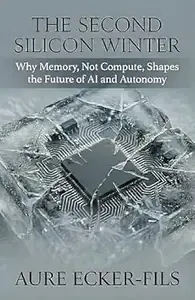
The Second Silicon Winter: Why Memory, Not Compute, Shapes the Future of AI and Autonomy
English | 23 Jan. 2026 | ASIN: B0GJG5X5LH | 323 pages | Epub | 786.29 KB
The Second Silicon Winter examines the moment the global technology stack crossed a threshold it could not retreat from. Between January 8 and January 10, 2026, memory-not compute-became the binding constraint of modern AI. The world did not experience a temporary shortage or a supply‑chain accident. It encountered a structural limit. This book reframes that week as a phase transition: the point at which CAR (Compute Absorption Rate) and MAR (Memory Absorption Rate) both exceeded 1.0, forcing compute, autonomy, and digital infrastructure into a new regime. The result was the emergence of the Memory Climate , a world where retention, locality, and continuity determine capability. Moving beyond the logic‑centric narratives of the Chip War era, The Second Silicon Winter provides a systems‑level account of how AI, memory, and geopolitics converged on the same bottleneck. It explains why DRAM became the new transistor , why HBM turned into a strategic resource , why NAND became continuity , and why cold memory became identity . It shows how the shift from stateless to stateful intelligence reorganized the economics of autonomy and reshaped the hierarchy of global power. The book introduces CAR and MAR as diagnostic tools for understanding the collapse of the old scaling laws. CAR explains how compute demand absorbed every incremental unit of supply. MAR explains why memory demand grew even faster, driven by stateful agents, long‑context inference, Engram architectures, and the rise of autonomous systems that accumulate experience rather than simply execute functions. Through this lens, the Second Silicon Winter becomes legible as a structural event. Sovereigns rose to the top of the allocation ladder. Hyperscalers reorganized around memory locality. Enterprises confronted retention as a cost, a liability, and a strategic asset. Consumers became the overflow tier of a permissioned world. Memory scarcity stratified intelligence. The book also examines how autonomy, robotics, and agentic systems became memory‑bound. It shows why the future of intelligence depends not on FLOPs, but on the physical substrate required to remember. It traces how identity moved from parameters to cold memory, and how the thermodynamics of retention became the limiting factor of artificial selfhood. The Second Silicon Winter is not a prediction. It is a structural map of the forces already shaping the next decade of AI, autonomy, and global technology strategy. It offers a clear framework for understanding how nations, hyperscalers, and emerging architectures are adapting to a world where memory-not compute-defines the frontier. For readers interested in AI infrastructure, semiconductor economics, digital sovereignty, or the long‑term trajectory of autonomous systems, this book provides a rigorous account of the Memory Climate and the constraints that now govern it.
Buy Premium From My Links To Get Resumable Support,Max Speed & Support Me
Rapidgator
u83fl.7z.html
DDownload
u83fl.7z
AlfaFile
u83fl.7z
Links are Interchangeable - Single Extraction

