
[align=center]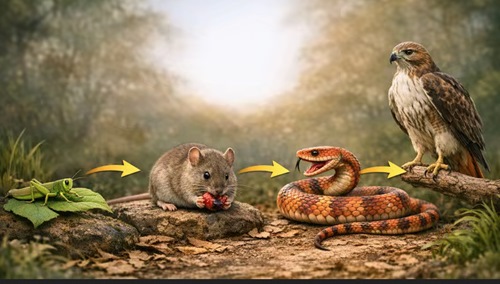
Biology Igcse Course Unit 19
Published 6/2026
MP4 | Video: h264, 1920x1080 | Audio: AAC, 44.1 KHz, 2 Ch
Language: English | Duration: 1h 18m | Size: 1.65 GB
Organisms and their Environment
What you'll learn
In this course students will learn exactly what they need to know for their Biology IGCSE exams. Students will learn about
1. State that the Sun is the principal source of energy input to biological systems
2. Describe the flow of energy through living organisms
3.Describe a food chain as showing the transfer of energy from one organism to the next, beginning with a producer
4. Construct and interpret simple food chains
5. Describe a food web as a network of interconnected food chains and interpret food webs
6. Describe a producer as an organism that makes its own organic nutrients, usually using energy from sunlight, through photosynthesis[/center]
7. Describe a consumer as an organism that gets its energy by feeding on other organisms
8. State that consumers may be classed as primary, secondary, tertiary and quaternary according to their position in a food chain
9. Describe a herbivore as an animal that gets its energy by eating plants
10. Describe a carnivore as an animal that gets its energy by eating other animals
11. Describe a decomposer as an organism that gets its energy from dead or waste organic material
12. Use food chains and food webs to describe the impact humans have through overharvesting of food species and through introducing foreign species to a habitat
13. Use food chains and food webs to describe the impact humans have through overharvesting of food species and through introducing foreign species to a habitat
14. Discuss the advantages of using a pyramid of biomass rather than a pyramid of numbers to represent a food chain
15. Describe a trophic level as the position of an organism in a food chain, food web or ecological pyramid
16. Identify the following as the trophic levels in food webs, food chains and ecological pyramids
17. Identify the following as the trophic levels in food webs, food chains and ecological pyramids
18. Discuss the advantages of using a pyramid of energy rather than pyramids of numbers or biomass to represent a food chain
19. Explain why the transfer of energy from one trophic level to another is often not efficient
20. Explain, in terms of energy loss, why food chains usually have fewer than five trophic levels
21. Explain why it is more energy efficient for humans to eat crop plants than to eat livestock that have been fed on crop plants
22. Describe the carbon cycle, limited to: photosynthesis, respiration, feeding, decomposition, formation of fossil fuels and combustion
23. Describe the nitrogen cycle with reference to
(a) decomposition of plant and animal protein to ammonium ions
(b) nitrification
(c) nitrogen fixation by lightning and bacteria
(d) absorption of nitrate ions by plants
(e) production of amino acids and proteins
(f) feeding and digestion of proteins
(h) deamination
(i) denitrification
24. State the roles of microorganisms in the nitrogen cycle
25. Describe a population as a group of organisms of one species, living in the same area, at the same time
26. Describe a community as all of the populations of different species in an ecosystem
27. Describe an ecosystem as a unit containing the community of organisms and their environment, interacting together
28. Identify and state the factors affecting the rate of population growth for a population of an organism
29. Identify the lag, exponential (log), stationary and death phases in the sigmoid curve of population growth
30. Interpret graphs and diagrams of population growth
31. Explain the factors that lead to each phase in the sigmoid curve of population growth
Requirements
Access to a device to watch lessons - phone, tablet, or computer No textbook needed - everything is covered in the course
Description
This Biology course is structured specifically around the latest Cambridge IGCSE and GCE Biology syllabus, ensuring complete and accurate coverage of every objective students need to master for their examinations. Students preparing for AP Biology, IB Biology, or equivalent international curricula will also find this course highly valuable for building a thorough understanding of the theory component of their exams, as the core biological concepts covered are closely aligned across these specifications.
The course focuses onUnit 19: Organisms and Their Environment, a unit that brings together energy flow, food chains and food webs, nutrient cycles and population dynamics in a way that examiners test consistently and in real-world contexts across all papers. Every syllabus objective is covered in full, with zero gaps.
Every syllabus objective is covered comprehensively, without overloading you with irrelevant material. The content is precise, focused, and directly aligned with what examiners expect - so you spend your time learning exactly what matters and nothing that does not. Throughout every lesson, real past paper questions are used to show you how this unit is examined, what a full-mark answer looks like, and the common mistakes that cost students marks every single year. You will know not just what to say, but how to say it - and equally importantly, what not to write.
The course builds strongexam technique alongside content knowledge, covering every question type across Papers 1, 2, 3 and 4 - from multiple choice and short answer to structured and extended response questions. Students leave this course knowing exactly how to approach any question on this unit regardless of how it is worded.
Every video lesson comes with adownloadable PDF resource that contains everything you need to know for that specific lesson - definitions, diagrams, key points and exam tips - all written and structured to match exactly what the syllabus requires. There is no need to open a textbook, search for revision guides, or look anything up online. Simply watch the lesson, download скачать the PDF, study from it, and go straight to past papers. Everything you need is right here in one place.
This unit is entirely theory-based - there are no practical experiments associated with it. This means every minute of the course is focused purely on building the depth of knowledge, precise scientific language and exam technique needed to score full marks across all theory papers. Particular attention is given to the areas students find most challenging - including constructing and interpreting pyramids of numbers, biomass and energy, explaining the nitrogen cycle in the precise sequence examiners expect, interpreting population growth curves correctly, and applying food web knowledge to unfamiliar ecological scenarios.
This course is ideal for students aiming for high achievement and A* grades in Biology examinations.
Who this course is for
IGCSE Biology Students Preparing for External Exams
https://rapidgator.net/file/ccbf040b79c72e5c99da69f792272405/Biology_IGCSE_Course_Unit_19.part2.rar.html
https://rapidgator.net/file/d61b45b83ec … 1.rar.htmlhttps://nitroflare.com/view/0A51F9F6CC1 … .part2.rar
https://nitroflare.com/view/A40B44A4E04 … .part1.rar

